Research Article | | Peer-Reviewed

A Multi‑pollutant Ventilation Strategy Under the Indoor Air Quality Procedure for Single‑family Houses

Received: 1 August 2026     Accepted: 11 August 2026     Published: 8 September 2026
Views:       Downloads:
Abstract

Balancing energy consumption and indoor air quality (IAQ) in single‑family houses is challenging because cooking‑generated PM2.5 and volatile organic compounds (VOCs) are episodic and occupancy‑dependent, and prescriptive ventilation rates cannot follow these transient loads. The ASHRAE 62.1 Indoor Air Quality Procedure (IAQP) offers a performance‑based alternative that permits reduced ventilation when contaminant levels remain within limits, but a validated residential strategy that combines real‑time occupancy with continuous CO2, PM2.5, and VOC sensing has not been demonstrated. This study proposes an occupancy–indoor environmental quality (OCC‑IEQ) strategy and evaluates it alongside fixed‑thermostat, schedule‑based (SCH), and occupancy‑triggered (OCC) controls using a co‑simulation of a multi‑zone house. The strategies are assessed against IAQ limits of PM2.5 ≤ 15 µg/m3, CO2 ≤ 900 ppm, and TVOC ≤ 500 µg/m3, with a minimum energy saving target of 15%. The OCC‑IEQ strategy achieves a 33.3 % reduction in annual HVAC energy cost, and maintains all three pollutants within limits. The schedule‑based and occupancy‑triggered strategies failed to control PM2.5, and the occupancy‑triggered strategy yielded limited energy savings due to overnight temperature drift. By treating permissible concentration bands as an operational resource, OCC‑IEQ dynamically modulates the outdoor air fraction to balance energy efficiency and indoor air quality protection. These findings demonstrate that a performance‑based multi‑pollutant ventilation strategy guided by the IAQP can achieve substantial energy savings and comprehensive IAQ compliance in dwellings.

Published in Journal of Energy, Environmental & Chemical Engineering (Volume 11, Issue 3)
DOI 10.11648/j.jeece.20261103.12
Page(s) 76-83
Creative Commons

This is an Open Access article, distributed under the terms of the Creative Commons Attribution 4.0 International License (http://creativecommons.org/licenses/by/4.0/), which permits unrestricted use, distribution and reproduction in any medium or format, provided the original work is properly cited.

Copyright

Copyright © The Author(s), 2026. Published by Science Publishing Group

Keywords

Residential Ventilation, Indoor Air Quality, Co-simulation, IEQ Sensing

1. Introduction
Single‑family houses present a ventilation challenge that is distinct from commercial buildings. Pollutant sources are episodic, tightly coupled to occupancy, and unevenly distributed across rooms . Occupants generate CO2 in proportion to their number and activity level . Cooking events release intense bursts of PM2.5 and volatile organic compounds (VOCs) , while building materials and furnishings continuously emit VOCs . These three contaminant groups, CO2, PM2.5 and VOCs, exhibit distinct temporal profiles that a fixed outdoor airflow rate cannot track, often leading to over‑ventilation during vacant periods or insufficient dilution when emissions peak .
Most installed residential systems still operate on temperature-driven or timer-based control. Such strategies meet thermal setpoints but ignore real-time contaminant levels. Demand-controlled ventilation (DCV) has been introduced to modulate airflow in response to sensor signals, yet most field deployments rely on a single input, commonly CO2 or passive-infrared occupancy . These systems therefore fail to address the distinct temporal dynamics of PM2.5 and VOCs simultaneously. A validated control approach that integrates real-time occupancy sensing with continuous multi-pollutant monitoring remains largely unexplored in housing.
ASHRAE Standard 62.1-2025 provides two distinct compliance paths: the prescriptive Ventilation Rate Procedure (VRP), which sets minimum outdoor airflow based on floor area and design occupancy, and the performance-based Indoor Air Quality Procedure (IAQP), which allows ventilation rates to be reduced or dynamically varied as long as all specified contaminant concentrations remain within acceptable limits. The 2025 revision places greater emphasis on direct sensor feedback and outcome verification, yielding a technical framework that supports IAQP-based strategies, including those using multiple pollutant signals . Nevertheless, no practical residential strategy fusing real-time occupancy with continuous pollutant signals to exploit the full energy and IAQ benefits of IAQP has been demonstrated.
To determine the achievable performance of such a strategy, this study implements four ventilation control logics inside a co-simulation environment coupling EnergyPlus and CONTAM. The platform resolves multizone airflow, contaminant transport, HVAC system dynamics, and energy-metered consumption for a representative single-family house. The four cases compared are: (i) fixed thermostat baseline, (ii) schedule-based ventilation, (iii) occupancy-triggered control, and (iv) a combined strategy that responds to both occupancy and indoor environmental quality (IEQ), using real-time CO2, PM2.5, and VOC readings to modulate ventilation. Performance is assessed by the ability to keep all three pollutants within the key performance indicator limits and by the associated HVAC operating energy cost. Cooking is modelled as an additional PM2.5 and VOC source, identifying the kitchen as the critical zone that drives peak ventilation demand. The results quantify the extent to which an IAQP-informed, multi-signal DCV approach can eliminate unnecessary HVAC runtime while maintaining acceptable IAQ, offering a concrete pathway for translating the IAQP framework into residential ventilation practice.
2. Methodology
This study employed a co-simulation framework coupling EnergyPlus with CONTAM to replicate the thermal, airflow, and contaminant transport dynamics of a representative single‑family house. The building model, occupancy schedules, contaminant sources, HVAC system configuration, control strategies, and performance metrics are detailed in the following subsections.
2.1. Co-simulation Framework
The coupling between EnergyPlus and CONTAM was implemented through the Functional Mock-up Interface . At each time step, EnergyPlus transmitted zone temperatures and system airflows to CONTAM, and then returned interzone infiltration airflows after solving multizone contaminant transport. The NIST CONTAM 3D Exporter tool processed the CONTAM project file and the original EnergyPlus input file, producing a modified EnergyPlus input file and a compressed Functional Mock-up Unit containing the required data exchange parameters. Contaminant concentrations, HVAC energy consumption, and total energy cost were extracted from the EnergyPlus output files after each simulation.
2.2. Building Model and Occupancy
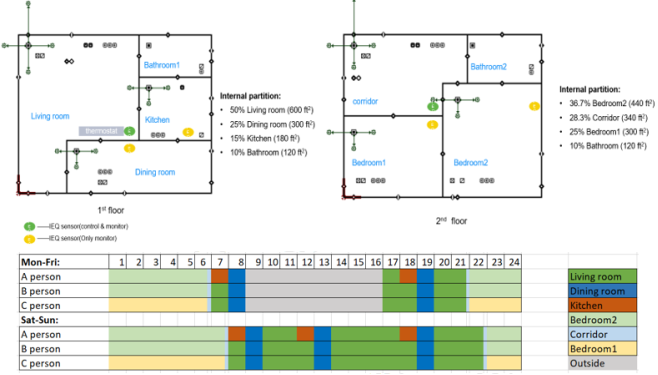
Figure 1. Building design and residential occupancy schedule.
The building represents a single-family house with a heated basement, divided into different thermal zones: basement, living room, kitchen, dining room, corridor, bathrooms and bedrooms, as shown in Figure 1. Each zone is equipped with supply and return air terminals, and separate exhaust fans serve the kitchen and bathroom. Envelope leakage and internal airflow paths were defined in CONTAM through leakage area elements. Occupancy schedules were derived from the American Time Use Survey . The living room is occupied mainly in the evening with brief morning presence on weekdays and continuously during the day on weekends. The bedrooms are occupied overnight.
2.3. Contaminant Sources
Outdoor CO2 was held constant at 719 mg/m3 (393 ppm), and indoor CO2 generation was set to 0.3 L/min per person during occupied periods, corresponding to an average-sized adult engaged in light office-type activity . Outdoor PM2.5 concentrations were taken from the U. S. EPA Air Quality System and indoor PM2.5 emission rate from occupants following the ASHRAE 62.1 User’s Manual , and a first-order deposition rate of 0.5 h⁻¹ was applied uniformly in all zones. Cooking in the kitchen was modelled as an episodic source emitting 2.3 mg/min of PM2.5 . Occupant-related TVOC emission was set to 2180 μg/h per person . Building material emission rates were 0.4 mg/(m2·h) for core zones and 0.35 mg/(m2·h) for perimeter zones . Cooking added a further TVOC source of 1.3 mg/min in the kitchen . Sensors for CO2, PM2.5 and TVOC were installed in the living room, dining room, kitchen, corridor, and both bedrooms, and their signals were routed to the EnergyPlus control logic via the CONTAM split function.
2.4. HVAC System and Control
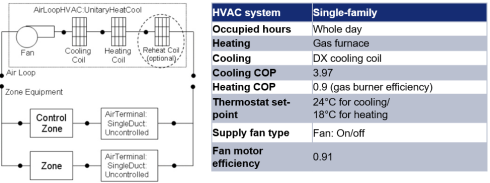
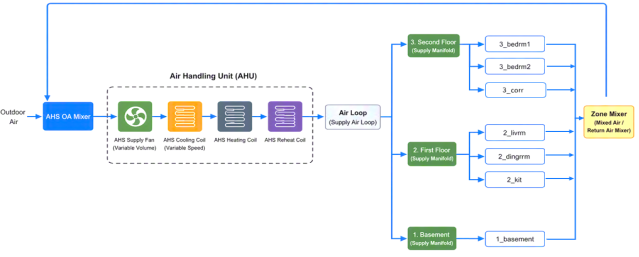
The air-conditioning system consists of a gas furnace with a direct-expansion cooling coil, modelled as an AirLoopHVAC: Unitary System in Figure 2. The air loop includes an outdoor air mixer, supply fan, cooling coil, heating coil, reheat coil, zone splitter, and zone mixer in Figure 3. Particle filters with a MERV-11 rating were placed in both the outdoor air intake and the return air path.
Figure 2. Schematic of HVAC system.
Figure 3. Schematic of Airloop HVAC system.
Four control logics were implemented and compared. The fixed-thermostat baseline maintains heating and cooling setpoints of 21°C and 24°C, operating solely on thermal demand. The schedule-based control switches the HVAC system on and off according to a preset weekly schedule. The occupancy-driven control activates ventilation only when zones are occupied and deactivates it after occupants leave. The occupancy–IEQ-driven control fuses real-time occupancy signals with concurrent CO2, PM2.5, and TVOC measurements, modulating the ventilation rate to keep all three pollutants within the limits while minimizing energy use.
2.5. Performance Metrics
Indoor air quality was evaluated against three key performance indicators: PM2.5 ≤ 15 μg/m3, CO2 ≤ 900 ppm, and TVOC ≤ 500 μg/m3 . An aggregated IAQ index was computed from the simulation outputs. HVAC energy consumption was obtained from EnergyPlus output meters for the cooling coil, heating coil, supply fan, and reheat coil. Energy costs were calculated using electricity and natural gas prices for Chicago. The energy-saving target was set at a minimum reduction of 15% relative to the fixed-thermostat baseline.
3. Results and Discussion
3.1. Energy Performance of Control Strategies
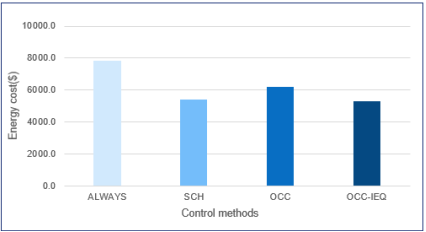
Figure 4 displays a clear cost gradient among the four strategies. The ALWAYS baseline generated the highest annual operating cost, roughly $7800, as it operated continuously in response to thermal load alone. In contrast, the occupancy-triggered strategy (OCC), which shuts down HVAC during unoccupied periods, saved only 20.5% ($6,200). Overnight temperature drift caused a large morning recovery peak that erased much of the nighttime saving . Moreover, infrared presence sensors without real‑time contaminant data enforce rigid on‑off cycles that degrade efficiency.
Figure 4. Annal energy cost for control methods.
The schedule-based strategy (SCH) avoided this penalty. By maintaining low-speed fan operation during off-peak hours, SCH preserved the building’s thermal inertia, dampened indoor temperature swings, and eliminated the severe morning peak that penalized OCC. As a result, the SCH strategy lowered the annual cost to approximately $5,400, representing a 31.0% saving and substantially outperforming the occupancy-only control.
The combined occupancy-IEQ strategy (OCC-IEQ) delivered the best overall performance, with an annual cost near $5,200 and a saving of 33%. It integrates real‑time CO2, PM2.5, and VOC signals to minimize outdoor air intake when indoor air quality is acceptable, sharply reducing the load from conditioning outdoor air. Ventilation increases only when pollutants approach thresholds. This fusion of occupancy detection and multi‑pollutant feedback achieves a balance between healthy indoor conditions and maximum energy efficiency.
3.2. Indoor Air Quality Analysis
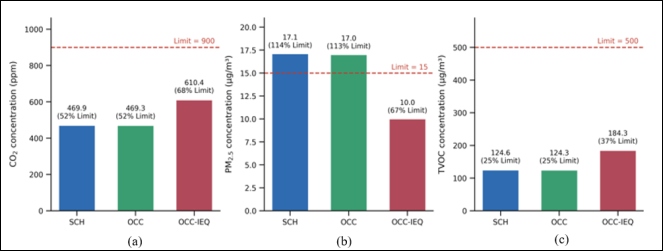
Figure 5 compares the indoor environmental quality compliance of the three dynamic strategies, namely SCH, OCC, and OCC‑IEQ, across the three target pollutants. Because the ALWAYS baseline maintained a fixed outdoor air fraction irrespective of occupancy or pollutant levels, it either over‑ventilated during clean periods or failed to respond to pollution spikes, resulting in the highest energy cost without guaranteeing IAQ compliance. The analysis therefore focuses on dynamic strategies to isolate the effect of different control logics on multi‑pollutant management.
Figure 5. Comparison of IEQ limit-control performance among control strategies (a) CO2, (b) PM2.5, (c) TVOC.
3.2.1. CO2 Control
Figure 5(a) compares the indoor CO2 concentrations achieved by the three dynamic strategies against the 900 ppm threshold. The average concentrations recorded for SCH and OCC were 469.9 ppm and 469.3 ppm, respectively. These values are nearly identical and remain far below the regulatory limit, indicating that both strategies supplied sufficient outdoor air to dilute occupant‑generated CO2 under the studied occupancy patterns . In the OCC‑IEQ case, the average CO2 concentration rose to 610.4 ppm, an increase of approximately 30 % relative to the other two strategies, yet this value still corresponds to only 68 % of the thresholds. The elevation is intentional and consistent with a demand‑controlled ventilation philosophy: rather than maintaining an unnecessarily low CO2 concentration, the OCC‑IEQ controller exploits the permissible concentration band to reduce outdoor‑air intake, thereby lowering the energy penalty of air conditioning without approaching the threshold where occupant comfort would be compromised.
3.2.2. PM2.5 Control
Figure 5(b) presents the average indoor PM2.5 concentrations obtained with the three strategies, plotted against the 15 μg/m3 limit. Both SCH and OCC failed to meet the particulate target; the recorded averages were 17.1 μg/m3 and 17.0 μg/m3, equivalent to 114 % and 113 % of the threshold, respectively. The exceedance is primarily driven by two mechanisms: the infiltration of outdoor particles combined with a ventilation rate that is not responsive to indoor particle levels, and the episodic generation of cooking aerosols that neither a timer‑based nor a presence‑based logic can anticipate . Because SCH operates on a pre‑defined schedule and OCC only reacts to occupancy, both supply a similar outdoor air flow during occupied hours and shut down or reduce flow at night, neither of which is synchronized with the real‑time particulate loads.
The OCC‑IEQ strategy achieved an average PM2.5 concentration of 10.0 μg/m3, only 67 % of the threshold value and more than 40 % lower than the levels recorded under SCH and OCC. This improvement is directly attributable to the integration of real‑time particle sensing into the ventilation control loop . When indoor PM2.5 sensors detect rising concentrations, the outdoor air damper is opened further to increase dilution, regardless of the occupancy status or time of day. Conversely, when outdoor PM2.5 exceeds 35 μg/m3, the damper closes to block the ingress of externally generated particles. This bidirectional, source‑specific modulation cannot be replicated by fixed schedules or occupancy‑only triggers. The OCC‑IEQ strategy was therefore the only strategy that achieved PM2.5 compliance throughout the occupied period.
3.2.3. TVOC Control
Figure 5(c) presents the TVOC concentrations recorded under the three strategies. SCH and OCC yielded average values of 124.6 μg/m3 and 124.3 μg/m3, respectively, both corresponding to approximately 25% of the 500 μg/m3 limit. The OCC IEQ strategy, however, yielded an average TVOC level of 184.3 μg/m3, which is approximately 48 % higher than the other two strategies but still represents only 37 % of the limit. This increase follows the same logic observed for CO2. When indoor air quality is acceptable, the integrated controller deliberately reduces the outdoor air fraction to save energy, allowing TVOC to rise moderately while staying well within the safety margin. During intense emission events such as cooking, the controller detects the simultaneous rise in TVOC and other pollutants and responds by increasing ventilation, thereby preventing any exceedance. All three strategies kept TVOC concentrations far below the regulatory limit, indicating that TVOC was not the governing pollutant for ventilation design in the studied house.
3.3. Combined Energy and IEQ Compliance
The energy cost results and the IEQ data together reveal a clear trade‑off. Both the OCC and SCH strategies satisfied the 15% energy‑saving target relative to the ALWAYS baseline and maintained CO2 and TVOC at levels far below the contaminant thresholds. However, neither strategy kept PM2.5 within the 15 μg/m3 limit. The energy savings achieved by OCC and SCH therefore came at the cost of persistent particulate exceedance, making them incomplete solutions from a combined energy and air quality perspective.
The OCC‑IEQ strategy resolved this tension. By allowing CO2 and TVOC to rise within the safe margin, it reduced outdoor air intake and the associated conditioning load, achieving a 33.3% energy cost saving. The integration of real‑time PM2.5 sensing drove the average particle concentration down to 10.0 μg/m3, well below the limit. No other strategy achieved simultaneous compliance with all three pollutant thresholds while exceeding the energy saving target.
This outcome illustrates the core principle of the ASHRAE 62.1 Indoor Air Quality Procedure, which treats ventilation as a performance‑based task rather than a prescriptive one . The OCC‑IEQ strategy uses the permissible concentration bands as an operational resource, relaxing dilution when air quality is acceptable and intensifying it only as contaminants approach their limits. The data confirm that this approach decouples energy efficiency from IAQ protection for CO2 and TVOC, while actively strengthening protection against PM2.5.
4. Conclusions
This study developed a co‑simulation framework to evaluate four ventilation control strategies in a single‑family house: fixed‑thermostat baseline (ALWAYS), schedule‑based (SCH), occupancy‑triggered (OCC), and a combined occupancy–indoor environmental quality strategy (OCC‑IEQ). The OCC‑IEQ strategy integrates real‑time CO2, PM2.5, and TVOC measurements into the ventilation control loop.
The OCC‑IEQ strategy reduced the annual HVAC energy cost by 33.3 % relative to the ALWAYS baseline, outperforming both the SCH strategy (31.0 % saving) and the OCC strategy (20.5 % saving). Critically, OCC‑IEQ was the only strategy that simultaneously maintained all three pollutant indicators within the limits. Both SCH and OCC control methods failed to maintain PM2.5 below the 15 µg/m3 limit, with average concentrations reaching 114% and 113% of the threshold. The poor energy performance of OCC relative to SCH was traced to overnight temperature drift and the resulting morning peak recovery load, a penalty that SCH avoided through off‑peak low‑speed fan operation. The OCC‑IEQ strategy exploits the allowable concentration bands as an operational resource, reducing outdoor air intake during clean periods and increasing it only when contaminants approach thresholds. This delivers energy savings, maintains CO2 and TVOC within limits, and substantially lowers PM2.5.
The findings provide quantitative evidence that a performance‑based, multi‑pollutant ventilation strategy aligned with the IAQP framework can simultaneously deliver substantial energy savings and comprehensive IAQ compliance in single‑family houses. Future work should incorporate stochastic occupancy models, dynamic outdoor air quality inputs, and extended field trials to further evaluate the robustness and generalizability of the OCC‑IEQ strategy across different climates and housing typologies.
Abbreviations

IEQ

Indoor Environment Quality

VOCs

Volatile Organic Compounds

PM2.5

Particulate Matter Within 2.5 μm Diameter

TVOC

Total Volatile Organic Compounds

CO2

Carbon Dioxide

HVAC

Heating, Ventilation, and Air Conditioning

DCV

Demand-Controlled Ventilation

IAQP

Indoor Air Quality Procedure

OCC

Occupancy-Driven Control

SCH

Schedule-Based Control

EPA

Environmental Protection Agency

ASHRAE

American Society of Heating, Refrigerating and Air-Conditioning Engineers

Author Contributions
Qiwen Jiang: Conceptualization, Data curation, Formal Analysis, Software, Writing – review & editing
Funding
This work is supported by IEQ Ventilation Analytic Development Project.
Data Availability Statement
The datasets used and/or analyzed during the study are available from the corresponding author upon reasonable request.
Conflicts of Interest
The author declares no conflicts of interest.
References
[1] Guyot, G., Sherman, M. H. and Walker, I. S. Smart ventilation energy and indoor air quality performance in residential buildings: A review. Energy & Buildings. 2018, 165(4), 416-430.
[2] Persily, A., de Jonge, L. Carbon dioxide generation rates for building occupants. Indoor Air. 2017, 27(5), 868–879.
[3] Poirier, B., Guyot, G., Geoffroy, H., Woloszyn, M., & Gonze, E. Pollutants emission scenarios for residential ventilation performance assessment. a review. Journal of Building Engineering. 2021, 42, 102488.
[4] Jode, M. D. Long term monitoring of CO2 levels and ventilation rates in a naturally ventilated residential apartment. Indoor Environments. 2024, 1(3), 100030.
[5] Buonanno, G., Morawska, L., Stabile, L. Particle emission factors during cooking activities. Atmospheric Environment. 2009, 43(19), 3235–3242.
[6] Sofowote, U. M., Dabek-Zlotorzynska, E., Yassine, M. M., Mooibroek, D., Siu, M., & Celo, V., et al. Combined-phase source apportionment of ambient PM2.5, PAHs and VOCs from an industrialized environment: consequences of photochemical initial concentrations. Atmospheric Environment, 2025, 340(1), 120894.
[7] Wang, H., Zhang, R., Kong, H., Wang, K., Sun, L, & Yu, X., et al. Long-term emission characteristics of vocs from building materials. Journal of hazardous materials. 2024 (12), 480.
[8] Majumder, A. K., Hossain, M. M., Rahman, M., Sobnam, M., Patoary, M. N. A. Spatial Distribution of Air Quality in Moulvibazar District Town, Bangladesh: A Wintertime Observation. Journal of Energy, Environmental & Chemical Engineering. 2025, 10(1), 12-25.
[9] Chen, H., & Markusson, C. Demand controlled ventilation in residential buildings, In Cold Climate HVAC 2018: Sustainable Buildings in Cold Climates, Kiruna, Sweden, March 12-15 (2018), 111-122.
[10] Hesaraki, A., Myhren, J. A., & Holmberg, S. Multi-zone demand-controlled ventilation in residential buildings: an experimental case study. Engineering Environmental Science. 2014, 1, 32860684.
[11] Taylor, S. T. Demand-controlled ventilation: CO2-based DCV using 62.1-2004. ASHRAE Journal. 2006, 48(5), 67-75.
[12] ASHRAE. ANSI/ASHRAE Standard 62.1-2025, Ventilation and Acceptable Indoor Air Quality. Peachtree Corners, GA: ASHRAE; 2025.
[13] Burley, B. What's new in ASHRAE standard 62.1-2025. ASHRAE Journal. 2026, 68(4), 12.
[14] Liang, W., Yu, X., & Yang, X. The ASHRAE indoor air quality procedure (IAQP): introduction of method and discussion on practical implementation. Building and Environment, 2026, 288, 114004.
[15] Bill McQuade, P. E., CDP, F. A., & LEED, A. Healthy Buildings: Designing for Life. ASHRAE Transactions. 2026, 132, XXI-XXIII.
[16] Wolkoff, P., Nielsen, G. D. Organic compounds in indoor air—their relevance for perceived indoor air quality? Atmospheric Environment. 2001, 35(26), 4407–4417.
[17] Dols, W. S., Emmerich, S. J., Polidoro, B. J. Coupling the multizone airflow and contaminant transport software CONTAM with EnergyPlus using co-simulation. Building Simulation. 2016, 9(4), 469–479.
[18] Bureau of Labor Statistics. American Time Use Survey Home Page. Available from:
[19] U. S. Environmental Protection Agency. Air Quality System (AQS). Available from:
[20] ASHRAE. Standard 62.1 User's Manual: Based on ANSI/ ASHRAE Standard 62.1-2019, Ventilation for Acceptable Indoor Air Quality. Peachtree Corners, GA: ASHRAE; 2021.
[21] Liu, Q., Son, Y. J., Li, L., Wood, N., Senerat, A. M., Pantelic, J. Healthy home interventions: Distribution of PM2.5 emitted during cooking in residential settings. Building and Environment. 2022, 207, 108448.
[22] Shanghai Research Institute of Building Sciences Group Co., Ltd. Indoor Environment and Material Emission Data Platform,
[23] Chen, C., Zhao, Y., Zhao, B. Emission Rates of Multiple Air Pollutants Generated from Chinese Residential Cooking. Environmental Science & Technology. 2018, 52(3), 1081-1089.
[24] Cheng, H., Raftery, P., Wendler, P. Re-optimizing Optimal Start and Morning Warmup. ASHRAE Journal. 2024, 66(8), 46.
[25] Lu, T., Lu, X., & Viljanen, M. A novel and dynamic demand-controlled ventilation strategy for CO2 control and energy saving in buildings. Energy and Buildings. 2011, 43(9), 2499-2508.
[26] Jiang, Q. W., Liu, J. L., Yang, X. Optimization of Indoor Quality and Thermal Comfort for University Classrooms Using Data-Based Machine Learning. E3S Web of Conferences. 2024, 546, 02011.
[27] Ma, Z., Huang, J., Wang, X., Wei, Y., Huang, L. Estimation of infiltration efficiency of ambient PM2.5 in urban residences of Beijing during winter. Journal of Building Engineering. 2023, 76, 107307.
[28] Stephens, B., Siegel, J. A. Penetration of ambient submicron particles into single-family residences and associations with building characteristics. Indoor Air. 2012, 22(6), 501–513.
[29] Farmer, D. K., Vance, M. E., Abbatt, J. P. D., Abeleira, A., Alves, M. R., Arata, C., Boedicker, E., Bourne, S., Cardoso-Saldaña, F., Cirtog, M., et al. Overview of HOMEChem: House Observations of Microbial and Environmental Chemistry. Environmental Science: Processes & Impacts. 2019, 21, 1280–1300.
[30] Gentile, V., Medina, L., Rubio Henriquez, M. J., Siegel, J. A., Tronville, P. Using low-cost particle sensors in HVAC ducts. Aerosol Science and Technology. 2025, 59(10), 1221–1238.
Cite This Article
  • APA Style

    Jiang, Q. (2026). A Multi‑pollutant Ventilation Strategy Under the Indoor Air Quality Procedure for Single‑family Houses. Journal of Energy, Environmental & Chemical Engineering, 11(3), 76-83. https://doi.org/10.11648/j.jeece.20261103.12

    Copy | Download

    ACS Style

    Jiang, Q. A Multi‑pollutant Ventilation Strategy Under the Indoor Air Quality Procedure for Single‑family Houses. J. Energy Environ. Chem. Eng. 2026, 11(3), 76-83. doi: 10.11648/j.jeece.20261103.12

    Copy | Download

    AMA Style

    Jiang Q. A Multi‑pollutant Ventilation Strategy Under the Indoor Air Quality Procedure for Single‑family Houses. J Energy Environ Chem Eng. 2026;11(3):76-83. doi: 10.11648/j.jeece.20261103.12

    Copy | Download

  • @article{10.11648/j.jeece.20261103.12,
      author = {Qiwen Jiang},
      title = {A Multi‑pollutant Ventilation Strategy Under the Indoor Air Quality Procedure for Single‑family Houses},
      journal = {Journal of Energy, Environmental & Chemical Engineering},
      volume = {11},
      number = {3},
      pages = {76-83},
      doi = {10.11648/j.jeece.20261103.12},
      url = {https://doi.org/10.11648/j.jeece.20261103.12},
      eprint = {https://article.sciencepublishinggroup.com/pdf/10.11648.j.jeece.20261103.12},
      abstract = {Balancing energy consumption and indoor air quality (IAQ) in single‑family houses is challenging because cooking‑generated PM2.5 and volatile organic compounds (VOCs) are episodic and occupancy‑dependent, and prescriptive ventilation rates cannot follow these transient loads. The ASHRAE 62.1 Indoor Air Quality Procedure (IAQP) offers a performance‑based alternative that permits reduced ventilation when contaminant levels remain within limits, but a validated residential strategy that combines real‑time occupancy with continuous CO2, PM2.5, and VOC sensing has not been demonstrated. This study proposes an occupancy–indoor environmental quality (OCC‑IEQ) strategy and evaluates it alongside fixed‑thermostat, schedule‑based (SCH), and occupancy‑triggered (OCC) controls using a co‑simulation of a multi‑zone house. The strategies are assessed against IAQ limits of PM2.5 ≤ 15 µg/m3, CO2 ≤ 900 ppm, and TVOC ≤ 500 µg/m3, with a minimum energy saving target of 15%. The OCC‑IEQ strategy achieves a 33.3 % reduction in annual HVAC energy cost, and maintains all three pollutants within limits. The schedule‑based and occupancy‑triggered strategies failed to control PM2.5, and the occupancy‑triggered strategy yielded limited energy savings due to overnight temperature drift. By treating permissible concentration bands as an operational resource, OCC‑IEQ dynamically modulates the outdoor air fraction to balance energy efficiency and indoor air quality protection. These findings demonstrate that a performance‑based multi‑pollutant ventilation strategy guided by the IAQP can achieve substantial energy savings and comprehensive IAQ compliance in dwellings.},
     year = {2026}
    }
    

    Copy | Download

  • TY  - JOUR
    T1  - A Multi‑pollutant Ventilation Strategy Under the Indoor Air Quality Procedure for Single‑family Houses
    AU  - Qiwen Jiang
    Y1  - 2026/09/08
    PY  - 2026
    N1  - https://doi.org/10.11648/j.jeece.20261103.12
    DO  - 10.11648/j.jeece.20261103.12
    T2  - Journal of Energy, Environmental & Chemical Engineering
    JF  - Journal of Energy, Environmental & Chemical Engineering
    JO  - Journal of Energy, Environmental & Chemical Engineering
    SP  - 76
    EP  - 83
    PB  - Science Publishing Group
    SN  - 2637-434X
    UR  - https://doi.org/10.11648/j.jeece.20261103.12
    AB  - Balancing energy consumption and indoor air quality (IAQ) in single‑family houses is challenging because cooking‑generated PM2.5 and volatile organic compounds (VOCs) are episodic and occupancy‑dependent, and prescriptive ventilation rates cannot follow these transient loads. The ASHRAE 62.1 Indoor Air Quality Procedure (IAQP) offers a performance‑based alternative that permits reduced ventilation when contaminant levels remain within limits, but a validated residential strategy that combines real‑time occupancy with continuous CO2, PM2.5, and VOC sensing has not been demonstrated. This study proposes an occupancy–indoor environmental quality (OCC‑IEQ) strategy and evaluates it alongside fixed‑thermostat, schedule‑based (SCH), and occupancy‑triggered (OCC) controls using a co‑simulation of a multi‑zone house. The strategies are assessed against IAQ limits of PM2.5 ≤ 15 µg/m3, CO2 ≤ 900 ppm, and TVOC ≤ 500 µg/m3, with a minimum energy saving target of 15%. The OCC‑IEQ strategy achieves a 33.3 % reduction in annual HVAC energy cost, and maintains all three pollutants within limits. The schedule‑based and occupancy‑triggered strategies failed to control PM2.5, and the occupancy‑triggered strategy yielded limited energy savings due to overnight temperature drift. By treating permissible concentration bands as an operational resource, OCC‑IEQ dynamically modulates the outdoor air fraction to balance energy efficiency and indoor air quality protection. These findings demonstrate that a performance‑based multi‑pollutant ventilation strategy guided by the IAQP can achieve substantial energy savings and comprehensive IAQ compliance in dwellings.
    VL  - 11
    IS  - 3
    ER  - 

    Copy | Download

Author Information